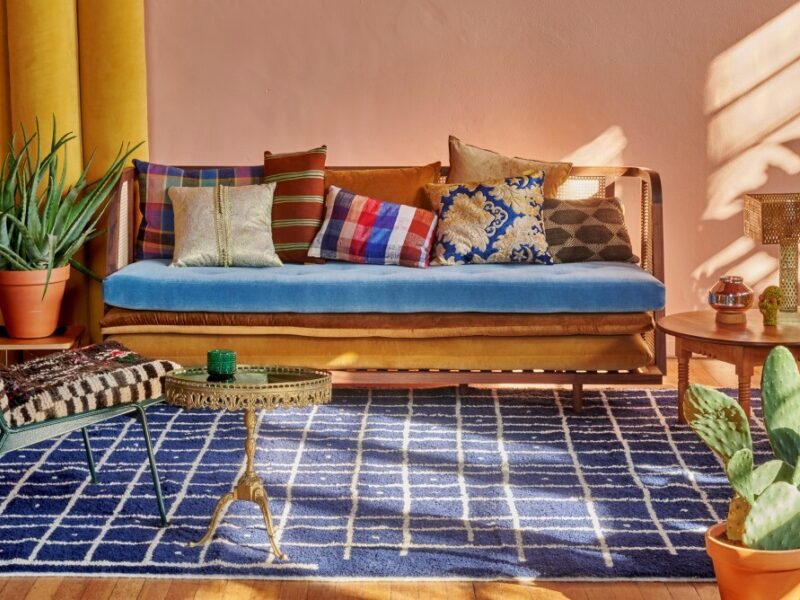
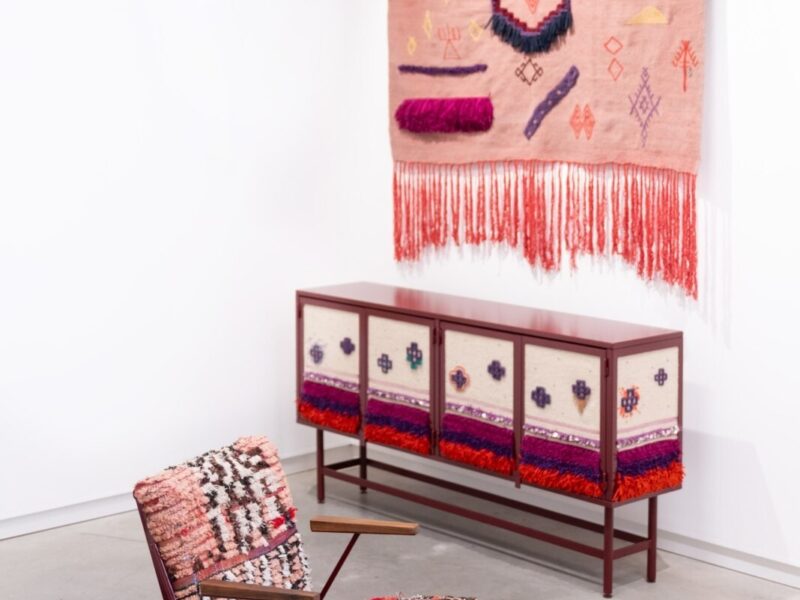
Starting in September, Museum Gouda will present Mina Abouzahra’s first solo museum exhibition. In her designs, she brings together the colorful worlds of Moroccan craftsmanship and Dutch design. At Museum Gouda, she will furnish a room with furniture and rugs that tell personal and cultural stories. She is also creating a number of new works especially for this exhibition, including a cabinet with textile panels full of symbols.
September 26, 2026 – March 27, 2027
Born in the Netherlands to Moroccan parents, Mina Abouzahra grew up immersed in two cultures. While studying at the Hout- en Meubileringscollege, she spent some time in Morocco, where she was introduced to the traditions of her parents’ homeland and the craft techniques that continue to inspire her to this day. Her work has since been included in various museum collections, and in 2022 she won a Dutch Creativity Award and a European Design Award. “Through my work, I keep my cultural heritage alive and give shape to my Moroccan identity,” says Mina Abouzahra.
Rugs as Storytellers
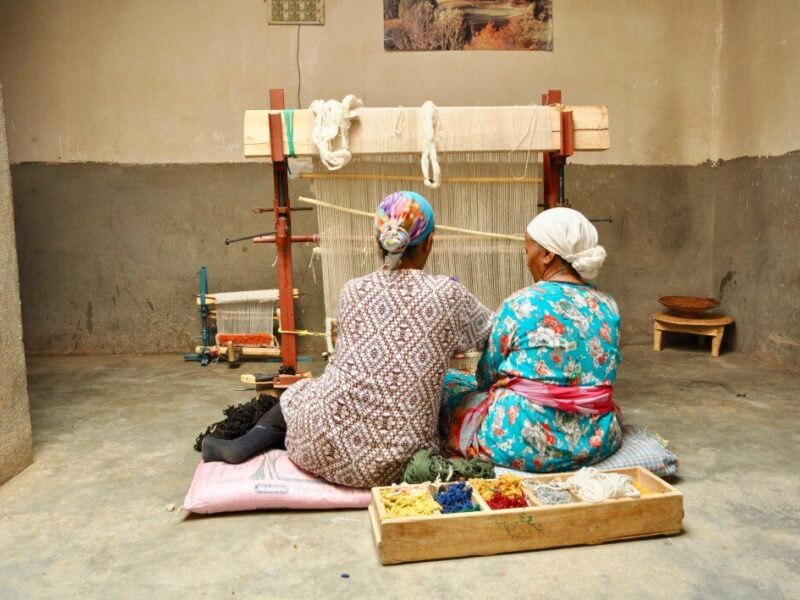
A Moroccan rug is never just a rug. The Amazigh, an indigenous people of North Africa, weave textiles rich in symbols that refer to femininity, fertility, marriage, protection, and death. For Amazigh women, a rug is thus a personal document in which stories about different stages of life are interwoven. Through colors, patterns, and symbols, the women pass down experiences and knowledge, generation after generation. The loom is not only a workplace but also a social gathering place where the weavers support one another, share stories, and keep traditions alive. Since 2013, Abouzahra has run a design studio in Amsterdam and in the southern Moroccan town of Taznakht. There, she collaborates with a women’s weaving cooperative that produces hand-knotted rugs and textiles according to centuries-old Amazigh traditions. In addition, she advocates for fair working conditions and equitable pay for the weavers.
New Work
A language is woven into every thread, telling stories of life, identity, and the invisible bonds between generations. This layered quality is also central to the small exhibition in Gouda, where Abouzahra blends raw materials, vibrant colors, and traditional techniques with contemporary design. Several new works are on display in the exhibition. Her latest piece , *Blessings*, is a cabinet incorporating numerous symbols. Traditionally, in the life of a Moroccan bride, the cabinet symbolizes a transition to independence. When she leaves her parents’ home, this is the only piece of personal furniture she takes with her to her new home. For this cabinet, Mina Abouzahra collaborated with two Dutch craft artists: Tsugi Woodworks crafted the wooden frame using Japanese joinery techniques, without the use of glue or nails. Het Borduurburo embellished the textile panels with various embroidery techniques.
Multi-layered furniture
Abouzahra always infuses her furniture with multiple layers—both literally and figuratively. For example , the Sofa Goity, constructed from stacked mattresses, is an ode to family ties and the way generations often live together in Morocco. The Abouzahra X Rietveld armchair is based on a timeless design by Wim Rietveld—son of the world-famous furniture designer and architect Gerrit Rietveld. It has since become a classic in Mina Abouzahra’s body of work, and the chair is part of the Rietveld Collection at the Centraal Museum in Utrecht. Here, she combines postwar Dutch minimalism with richly decorated, handwoven Moroccan textiles. “I recognize myself in both worlds,” she explains.
A Woven Letter
One of the highlights at Museum Gouda is the monumental tapestry *Brief*, which references a special tradition from Taznakht and from which the title of this exhibition is derived. When a young woman from the Amazigh community gets married and leaves her parents’ home, she has no direct contact with her family for the first year. During that time, she weaves a tapestry in which she uses colors and symbols to convey how she is doing. Her father visits her once and then brings this tapestry to her mother, who “reads” the woven “letter” based on the visual language of the weave.
Connection to Wonder Walls
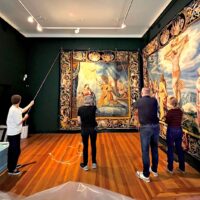
Coinciding with this solo presentation, Museum Gouda is hosting the major fall exhibition Wonder Walls, which explores the rich history of Gouda’s weaving industry. For this exhibition, Mina Abouzahra collaborates with Gouda communities to design contemporary cushions, woven in Taznakht, as modern interpretations of historical guild cushions. In doing so, she forges a surprising connection between Dutch textile history and the living Moroccan weaving tradition. Nearly one in ten residents of Gouda has roots in the northern Rif Mountains and Amazigh culture, so it is no coincidence that Museum Gouda is presenting Mina Abouzahra’s work.
Wonder Walls
Coinciding with this solo exhibition, Museum Gouda is hosting the major fall exhibition “Wonder Walls,” which explores the rich history of Gouda’s weaving industry. For this exhibition, Mina Abouzahra is collaborating with communities in Gouda to design contemporary cushions, woven in Taznakht, as modern interpretations of historic guild cushions. In doing so, she forges a surprising connection between Dutch textile history and the living Moroccan weaving tradition. Gouda is the most Moroccan city in the Netherlands; nearly one in ten residents of Gouda has roots in the northern Rif Mountains and Amazigh culture.