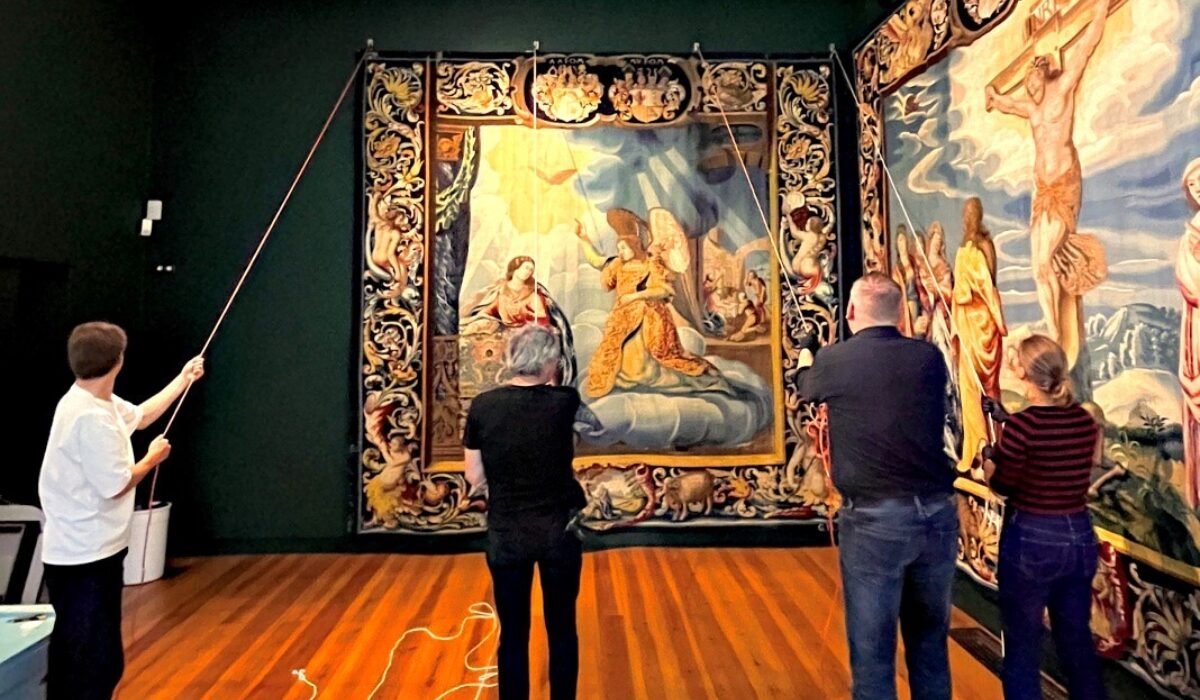
Two masterpieces from Skokloster Castle in Sweden are now also hanging on the wall. That was quite an undertaking. The two tapestries, depicting the Annunciation and the Crucifixion, were made between 1634 and 1647 in Gouda, in the workshop of master weaver Tobias Schaep. Wonder Walls – Woven Masterpieces opens to the public on Saturday.
Tobias Schaep was originally from Flanders but established a successful workshop in Gouda around 1605. His most famous surviving work is a series of eight tapestries depicting the life of Christ. Schaep created the series for the Danish noble couple Axel Arenfeldt and Margrethe Ulfeldt. Shortly after they were completed, they were taken to Sweden as spoils of war, where they have adorned the walls of the impressive Skokloster Castle ever since. Each tapestry is signed and is the only one of all surviving Gouda tapestries to bear the mark “G.H.” for Gouda Holland.
First major exhibition on tapestries in the Netherlands
For centuries, tapestries were the ultimate luxury item. For example, the tapestries Raphael designed for the Sistine Chapel cost as much as five times more than Michelangelo’s painted ceiling. Gouda was the center of this art of weaving in the Northern Netherlands, where in the 17th century some 450 tapestry weavers created works for clients from home and abroad. For this exhibition, masterpieces from Sweden, Paris, and the Rijksmuseum are returning after centuries to the city where they were once created. Museum Gouda is bringing them together in the first major exhibition in the Netherlands dedicated to this unique art form.
The patrons of these woven treasures included stadtholders, electors, and even the Swedish royal family. For example, during their state visit to Sweden, King Willem-Alexander and Queen Máxima stood in front of a series of life-size tapestries made in Gouda.
Read more about the exhibition “Wonder Walls – Woven Masterpieces” here.
The “Wonder Walls” exhibition was created in collaboration with the RKD – Netherlands Institute for Art History and is made possible in part by the Mondriaan Fund, the Cultuurfonds, with additional support from the Barbas-van der Klaauw Fund, VSBfonds, the Countess van Bylandt Foundation, Zonta Netherlands, and the Jac. Bezemer Foundation.