September 26, 2026 – March 29, 2027
In the 17th century, tapestries—not paintings—were the most luxurious art form. And Gouda was the most important center of tapestry art in the Netherlands. This fall, these meter-high works of art, which were once woven in the city, are returning briefly to their birthplace. For the first time in the Netherlands, Museum Gouda is bringing together a large number of these extraordinary tapestries. In the museum galleries, visitors can immerse themselves in enormous woven landscapes and mythical scenes.
Anyone who followed King Willem-Alexander and Queen Máxima’s state visit to Sweden in 2025 may have noticed the enormous tapestries in front of which the royal couple posed for photographers. These colorful works of art were created centuries ago in Gouda. They are normally displayed in castles and palaces both in the Netherlands and abroad, but this fall they will return, just this once, to the city where they were once woven.
Costly and time-consuming, but oh so beautiful
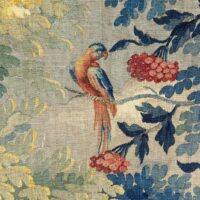
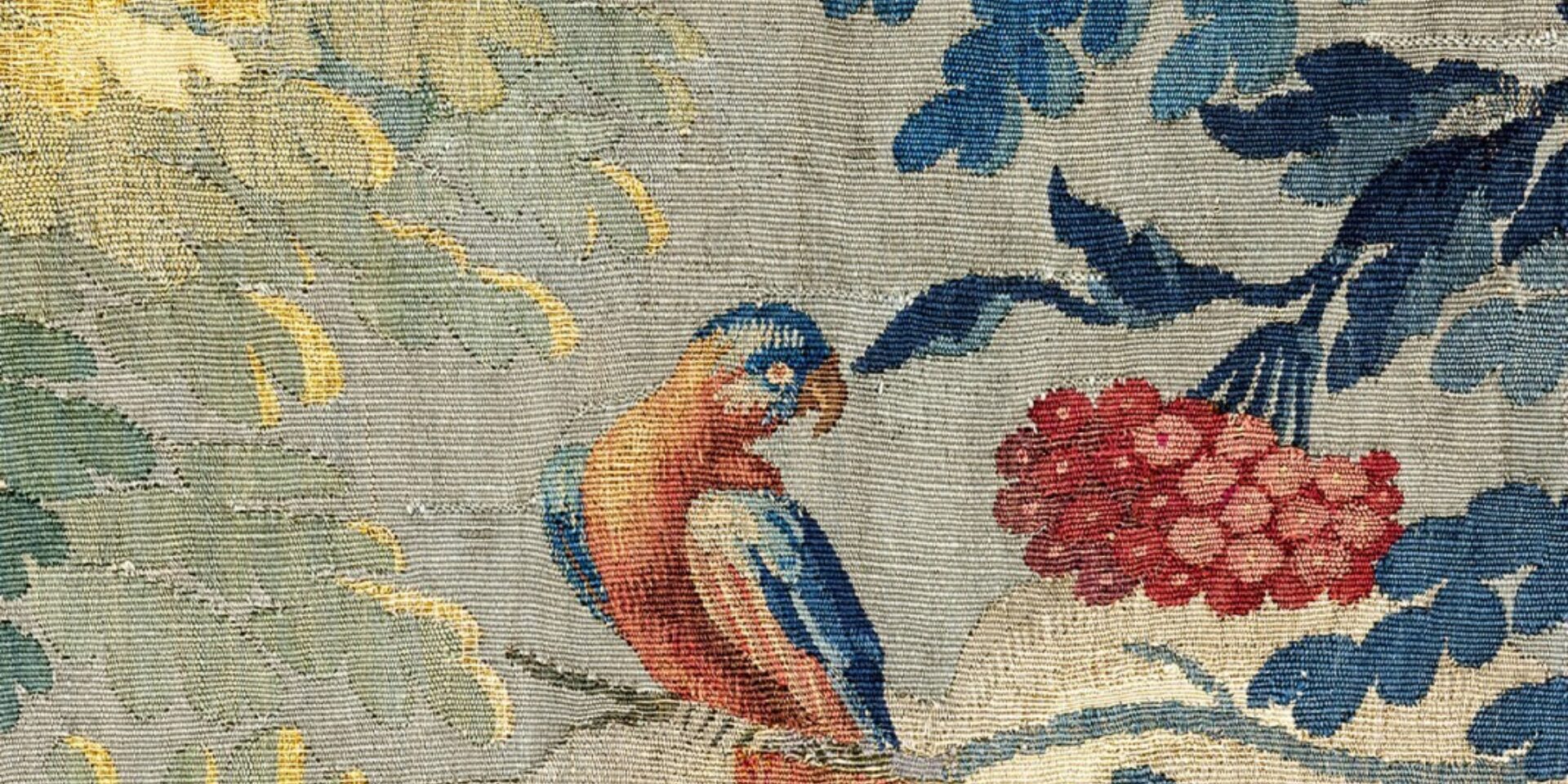
Tapestries were true status symbols in the 16th and 17th centuries. They were costly and very time-consuming to make and were used to decorate the grand halls of palaces and castles. Forest landscapes, exotic flowers, animals, and stories from mythology were woven with thousands of threads into works of art measuring several meters high.
Recent research shows that Gouda was an important center for this impressive art of weaving during that period and reveals who the key figures were. This story is still unknown to many residents of Gouda. Museum Gouda is changing that with “Wonder Walls – Woven Masterpieces.”
Largest exhibition on tapestries ever held in the Netherlands
The exhibition is the first of its kind in the Netherlands to explore the rich history of tapestry art on such a grand scale. Monumental tapestries from the Netherlands and abroad tell stories not only of luxury and wealth, but also of the people who created and traded them. Migration, international trade, the exchange of knowledge, and women’s entrepreneurship appear to have played a significant role in this.
Thus, a tapestry becomes more than just a beautiful decorative work of art: it also tells the story of the world in which it was created.
“Wonder Walls” also demonstrates why tapestries are so special: they combine artistic richness with mobility. Unlike murals, they can be rolled up and transported, allowing spaces to be transformed into richly decorated halls in a short time. Because of this, tapestries are also known as the “mobile frescoes of the North.”
Masterpiece from Gouda City Hall
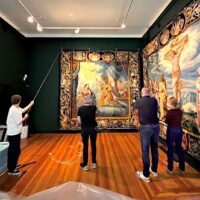
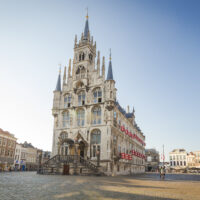
As early as the late 16th century, the Gouda city council began purchasing the first pieces for City Hall. The exhibition also features a monumental tapestry that has hung in Gouda City Hall ever since. Many Gouda residents have exchanged their wedding vows in front of this masterpiece: to this day, the landscape tapestry—over ten meters long—serves as the permanent backdrop for many weddings in Gouda. This year, City Hall is undergoing a major renovation, and this beloved tapestry is also being restored. As a rare exception, it is coming to Museum Gouda, before returning to its familiar home for centuries to come.
A Journey of Discovery
In this exhibition, visitors literally step into another world. Amid an overwhelming green landscape of deciduous trees, flowers, and birds, a setting full of details, vistas, and surprises unfolds. What at first appears to be a forest turns out, upon closer inspection, to be a richly decorated room. This experience serves as the starting point for a journey of discovery exploring the most important artists, their techniques and stories, and the international significance of tapestry art. Tapestry murals several meters high from collections in the Netherlands and abroad transform the museum walls into “wonder walls.” Behind the tapestries lies a world whose existence was previously virtually unknown. The exhibition answers questions such as: Who made these tapestries, how were they produced, and why did Gouda, in particular, play such an important role in this?
Gouda as an international center of tapestry art
From the 1580s onward, Gouda rapidly emerged as the leading center of tapestry production in the Northern Netherlands. Protestant Flemish artisans migrated north due to political and religious unrest, and Gouda actively welcomed them by offering free citizenship, tax breaks, and housing. The monasteries, which had stood empty since the Reformation, proved to be a perfect fit: they offered exactly the space needed for looms up to four meters wide. This gave rise to a thriving industry, in which an estimated 450 carpet makers were employed in the 17th century, spread across some forty workshops in the city. In the exhibition, a reproduction of a 16th-century map shows where those monasteries—and thus the weaving workshops—were located. For two centuries, the Flemish migrants gave Gouda an economic and artistic boost.
On the plush
Not only the walls but also the furniture was adorned with tapestry art during that period. For example, every member of a guild, or anyone serving on the city council or as mayor, had their own cushion. The museum also draws a connection to the present. In a special art project, designer Mina Abouzahra collaborated with contemporary “guilds”—ranging from a girls’ soccer team to a choir and a gardening club—to design their own cushions. The cushions are woven in Morocco using techniques that differ little from those of centuries ago, and they are also featured in the exhibition.
Audio Tour
An audio tour accompanies the exhibition, in which curator Ingmar Reesing highlights details that are easy to overlook.
Publication
Museum Gouda is independently producing a small illustrated publication to accompany this exhibition.
Public Program
Museum Gouda is organizing an extensive public program around “Wonder Walls,” ranging from an in-person “yap & yarn” evening to workshops where visitors can get creative with textiles. Up-to-date information about the program can be found on the museum’s website.
Also on view: Mina Abouzahra - Woven Letters
Concurrent with Wonder Walls, Mina Abouzahra’s solo exhibition Woven Letters is on view at Museum Gouda, featuring tapestries and furniture she has created recently. Her designs bring together the colorful worlds of Moroccan craftsmanship and Dutch design.
The exhibition “Wonder Walls” was organized in collaboration with the RKD – Netherlands Institute for Art History and is made possible in part by the Mondriaan Fund, the Cultuurfonds, with support from the Barbas-van der Klaauw Fund, VSBfonds, the Gravin van Bylandt Foundation, Zonta Netherlands, and the Jac. Bezemer Foundation.