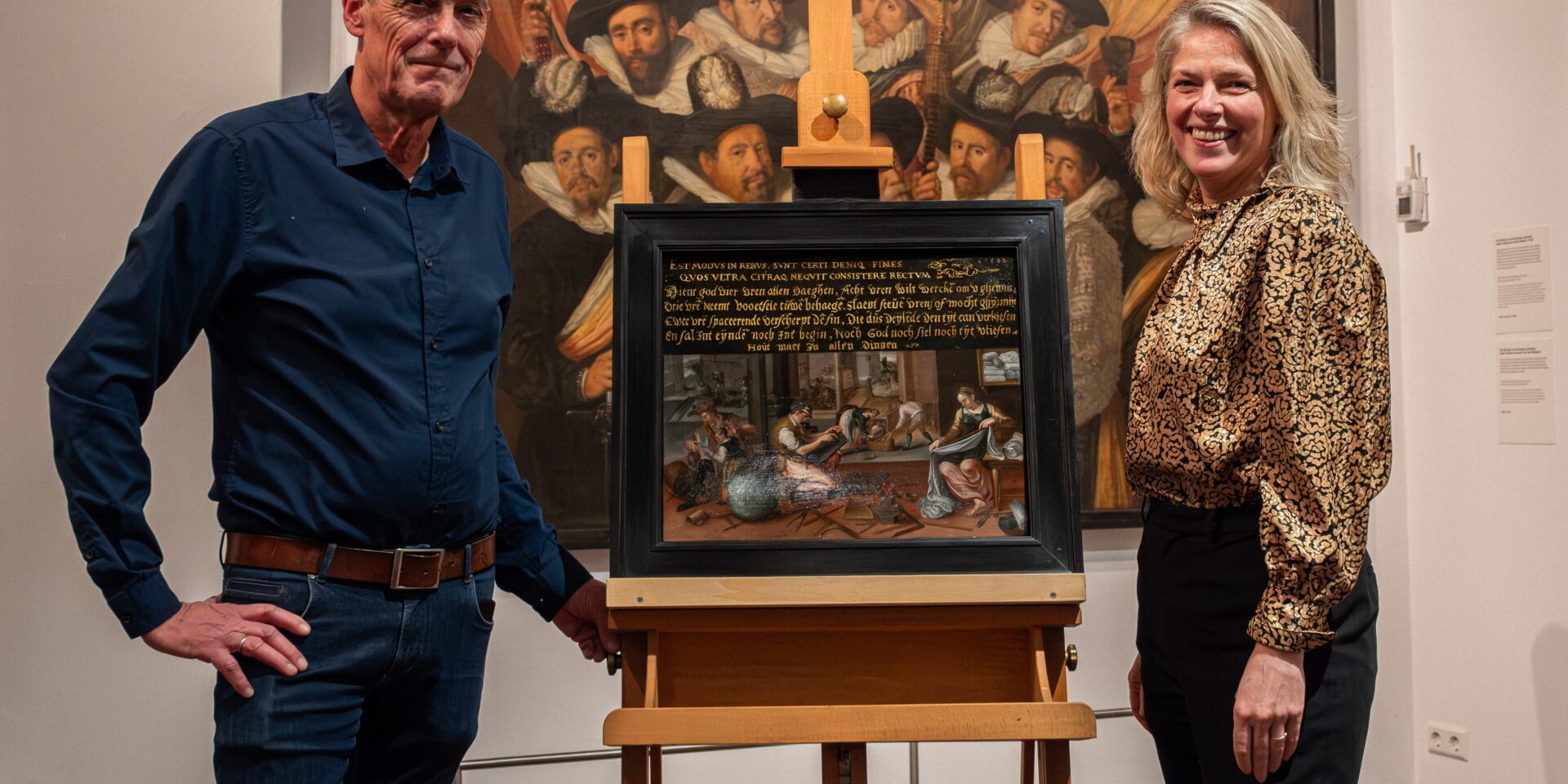
Following a tip from an American art dealer, Museum Gouda acquired a remarkable 16th-century painting at an art auction in Paris. The panel painting depicts several colorful figures engaged in measuring and weighing. The depiction, dating from 1582, corresponds exactly with a drawing by the Gouda glassmaker Wouter Pietersz Crabeth. It is therefore presumed that the painting originated from Crabeth’s studio or his immediate circle. This makes the panel an important discovery. It was recently restored and was donated to the museum today by the Association of Friends of Museum Gouda to mark the museum’s 150th anniversary.
In the spring of 2024, an American art dealer brought the auction of an unknown panel at the Daguerre auction house in Paris to the attention of Museum Gouda. The resemblance to a drawing in the collection of the École Nationale Supérieure des Beaux-Arts in Paris piqued the museum’s interest. This drawing has been attributed by Crabeth expert Szuszanna van Ruyven to the Gouda glass painter Wouter Pietersz (I) Crabeth (1510–1589). This made it likely that the panel, which had been recorded as Flemish, was in fact from Gouda.
Anniversary gift
Museum Gouda is celebrating its 150th anniversary this year, and the Friends of the Museum Association considered this remarkable discovery a fitting birthday gift. They managed to acquire the panel at auction for just €3,500, and the association subsequently had it restored. The painting is executed on wooden planks glued together. Over the centuries, seams and cracks had formed. During an extensive restoration, the panel was repaired, the painting restored, and the work was given a new and more suitable frame. There is a measure in all things
The painting was created in 1582 and features a unique composition with two texts. The first is a quote from the Roman poet Horace that begins with Est modus in rebus—there is a measure in all things. The second text is in (Old) Dutch and concerns the structure of the day. The painting contains a wealth of details and provides insight into how mathematics and geometry were applied in daily life in the sixteenth century, for example in land surveying, architecture, weighing scales, and astronomy. The work is a combination of science and art and paints a unique picture of the practical value of mathematical knowledge during the Renaissance.
An art history puzzle
The depiction is identical to the drawing by Wouter Pietersz (I) Crabeth. No paintings by him are known to exist. The depiction appears too detailed for a stained-glass window, the works that brought the Gouda artist fame and renown. The figures and the way the clothing is depicted in the panel also show stylistic similarities to the lower section of a monumental Joseph altar in Gouda, about whose creator little is known. Very little has survived from the 16th century, and not much is known about the Gouda painters of that period. This presents an interesting art-historical puzzle for curator Ingmar Reesing, who will continue to conduct further research.
Gouda Museum
Museum Gouda Hours: Tuesday through Sunday, 11:00 a.m. – 5:00 p.m.
See also: museumgouda.nl